
Anti-Reflective Surface Structures for Nonlinear Optics
Typical Coatings - Background
Typically, in the field of nonlinear optics we have used surface coatings (e.g., MgF₂, SiO₂, TiO₂), deposited using techniques such as e-beam,. In electron-beam evaporation (e-beam), IAD, Ion Beam Sputtering(IBS) and other thin-film deposition techniques to control surface reflectivity to eliminate unwanted stray beams and surface losses.The result is typically a multilayer stack in which each layer has a controlled refractive index and thickness.
Although such coatings have long been successful in managing reflections and losses on a wide range of optical materials, they can be a limiting factor in managing intense beams in high power/ high intensity lasers; either as a result of inherent absorption within the film, or as a result of the adhesion and structure of the interface between the coating and substrate. (Read more about coatings for nonlinear optics in our previous blog here)
This is especially true in nonlinear optical crystals which may exhibit structural anisotropy that is not matched to coating materials - potentially introducing additional stress at the interface. The result is often a reduced LIDT (Laser Induced Damage Threshold) relative to the bulk crystal, limiting the range of operation. The issue tends to be exacerbated at shorter wavelengths.
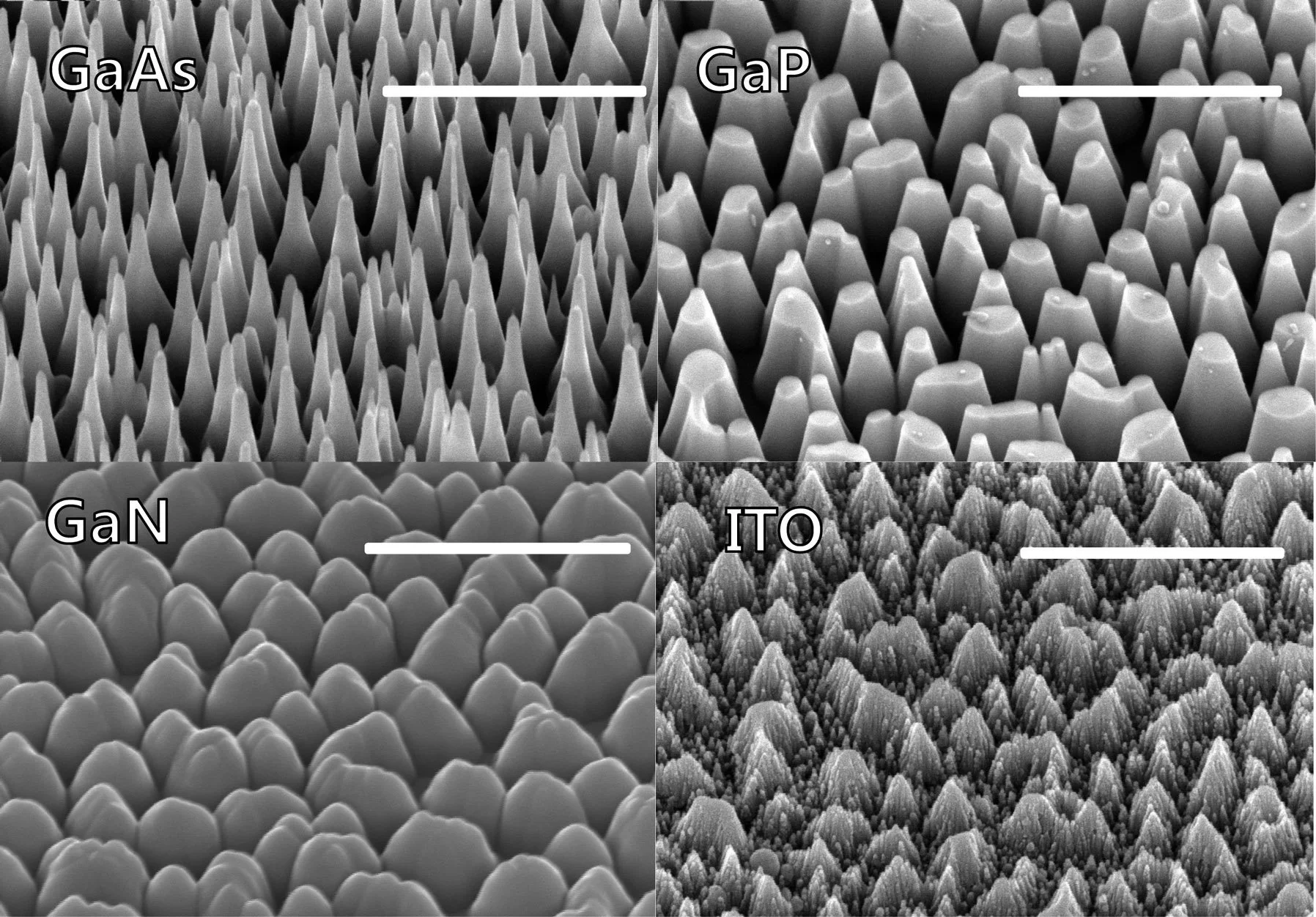
These are examples of ARSS on other types of materials.
GAMDAN Optics is investing in next-generation solutions like Anti-Reflective Structured Surfaces (ARSS) to address some of the issues with traditional, multi-layer coating techniques.
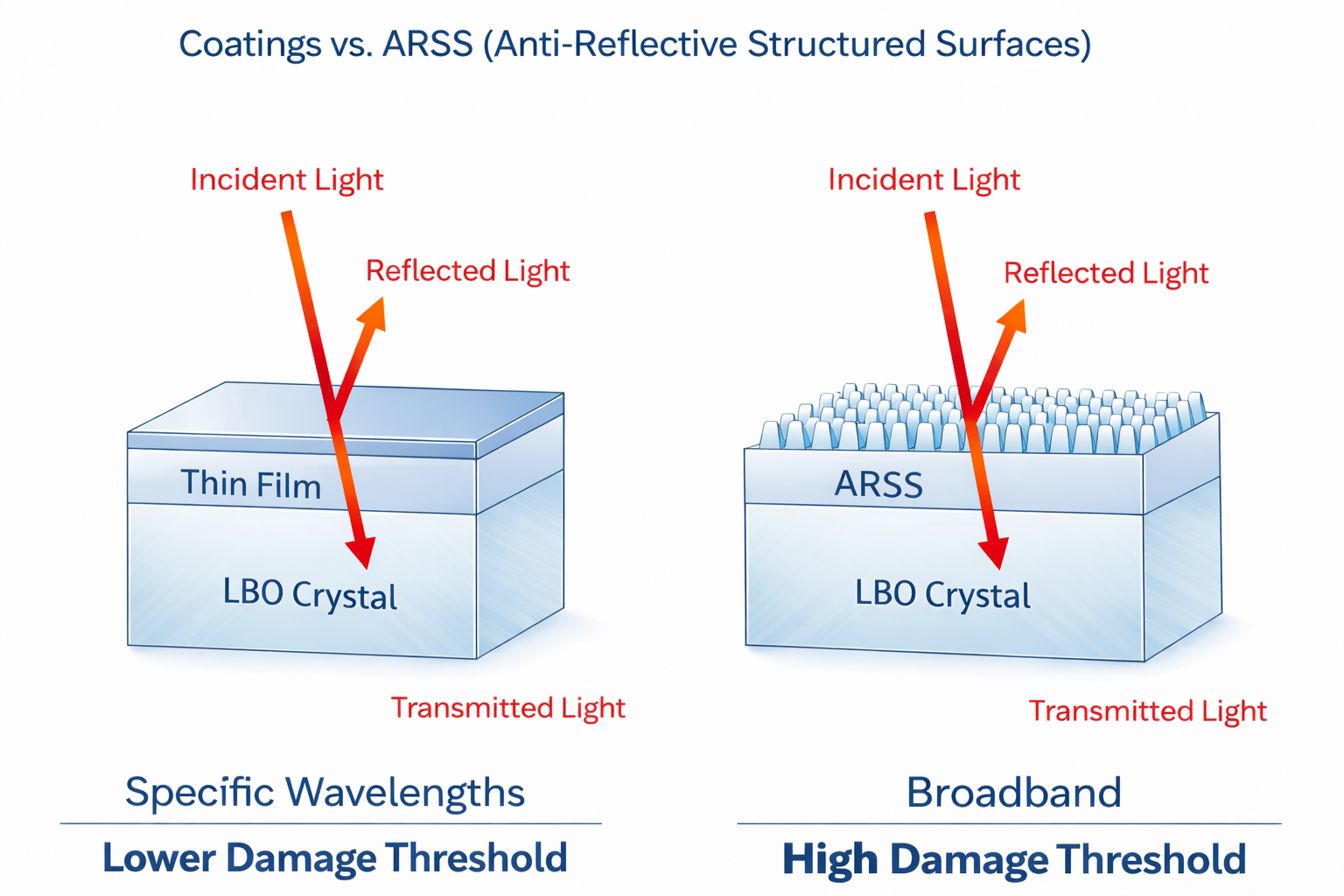
The research GAMDAN is conducting into ARSS directly addresses the optical limitations by eliminating the need for discrete layers, and non-matching thermo-mechanical materials properties. By creating a smooth, nanoscale transition layer within the original bulk material, it offers an effective gradient refractive index which is inherently less sensitive to the angle of incidence and can achieve ultra-broadband, near-zero reflection, and eliminates the potential material mismatch that can affect non-native material coatings.
A New Technology of Optical Coating
The technology known as Anti-Reflective Structured Surfaces (ARSS) uses microscopic surface patterns smaller than the wavelength of light to eliminate reflection. Instead of layering materials, ARSS relies on nano-patterned surface structures, typically conical or tapered features smaller than the wavelength of light.
These sub-wavelength “moth-eye” geometries create a gradient refractive index transition from air to substrate. This natural anti-reflection is what helps protect moths from predators.
The surface structures are often fabricated using laser interferometric patterns or nano-imprint lithography, and reactive ion etching (RIE) which mimics nature’s moth eye.
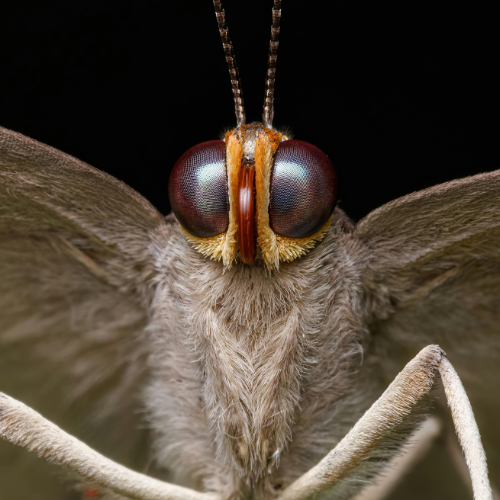
A moth up close
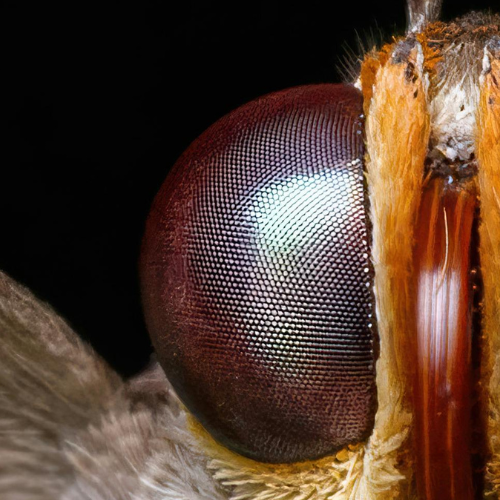
A moth eye zoomed in so you can see the texture
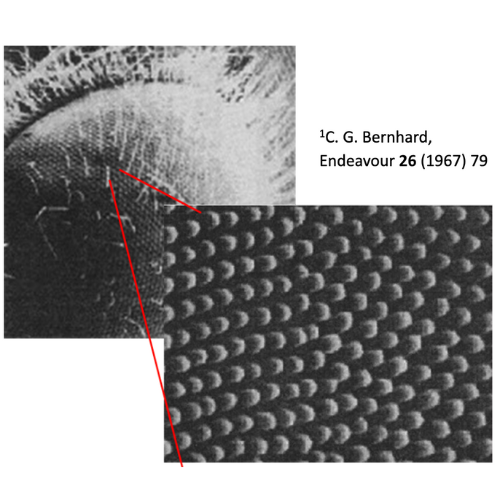
Moth eyes have submicron cones on the cornea (~220 nm) which reduces reflection in visible and enables survival from predatory owls.
Comparison of optical performance and durability
Thin-Film (e-beam/Sputtered):
Reflection can be reduced to <0.1% in narrow spectral bands but performance drops outside design wavelengths or incident angles.
Sensitive to layer thickness precision and index contrast; small deviations shift spectral response.
Can delaminate, crack, or shift under thermal cycling or high humidity if adhesion or stress is imperfect.
Hard sputtered coatings (e.g., IBS) improve durability but remain susceptible to interface defects.
ARSS:
Provides broadband and wide-angle antireflection, especially effective from UV through IR depending on structure geometry.
Because it’s a gradient index, not a discrete stack, it performs well under non-normal incidence and with polarized or high-power light.
Being monolithic with the substrate, there are no interfaces to fail or peel.
It can offer higher laser damage threshold and mechanical stability, though fabrication-induced subsurface damage must be minimized to maintain performance.
Why ARSS can be a breakthrough for LBO Crystal Solutions
LBO is the crystal of choice for high-power frequency conversion, second harmonic generation (SHG), third harmonic generation (THG) at 355 nm, and optical parametric oscillation (OPO/OPA). As laser pulses shorten and average power continues to climb, the crystal surfaces experience increasingly extreme power densities. Surface damage, output power loss, and beam distortion from localized absorption are among the most pressing challenges in high-power laser systems today.
The bottleneck, however, is not the crystal– it is the coating. Uncoated, super-polished LBO surfaces have survived fluences exceeding 95 J/cm² at 355 nm with nanosecond pulses, while the best single-layer AR coatings typically damage at only 20–30 J/cm². That represents a 3–5× gap between the crystal's intrinsic capability and what the deposited coating allows. For customers running high-power THG systems, the AR coating is the weak link limiting power, lifetime, and reliability.
Studies have shown that high-power THG operation can degrade coated LBO crystal performance in as little as 130–192 hours, with visible damage spots and output power losses of 15% or more. Under such conditions, nonlinear crystals effectively become consumables, meaning components with limited lifetime requiring periodic replacement or mechanical indexing to fresh spots on the crystal. Many systems now use automated crystal shifters that translate the crystal to fresh spots once efficiency drops, but this is a workaround, not a solution.
The coating failure problem is compounded by LBO's anisotropic thermal expansion, which does not match many thin-film coating materials. The mismatch leads to poor adhesion, film cracking, and delamination which shortens service life and limits system uptime. ARSS directly addresses this bottleneck. Because the anti-reflective structure is etched into the crystal surface itself rather than deposited on top of it, there is no film-substrate interface to fail.
Where ARSS research stands today
On simpler isotropic materials like fused silica, ARSS has already demonstrated reflection losses as low as 0.02% and laser damage thresholds as high as 100 J/cm², approaching the bulk material limit. The challenge has been extending these results to anisotropic crystals like LBO, where different crystal cut orientations exhibit distinct etch behavior and thermal diffusion profiles.
How GAMDAN Optics Is Advancing ARSS for High-Power LBO Crystals
GAMDAN Optics has identified nano-structured surfaces as a promising next-generation alternative to traditional vacuum-deposited coatings for nonlinear optics, noting their high resistance to optical damage. In collaboration with the University of North Carolina at Charlotte,GAMDAN researchers have demonstrated preliminary ARSS results on LBO crystal, achieving broadband transmission enhancement using fluorine-chemistry plasma etching, with nano-structured surfaces verified via scanning electron microscopy.
For GAMDAN Optics customers in industrial laser manufacturing, aerospace and defense, medical lasers, and scientific research the promise of ARSS on LBO is a surface treatment that approaches the bulk damage threshold rather than being constrained by a deposited film. This translates directly to longer crystal lifetime, higher achievable output power, reduced downtime and consumable cost, and elimination of the coating as “the weak link” problem that currently constrains high-power system design.
Invest in the Future of Optical Surface Technology
ARSS is an emerging technology with demonstrated performance advantages and significant commercial runway ahead. GAMDAN is looking for strategic R&D partners who share our vision for where nanostructured optics can go, and who are interested in co-developing the next generation of surface solutions for high-power laser and nonlinear applications.
We invite researchers, OEMs, and investment-minded collaborators to connect with us directly. Contact us to set up a discussion below.
INQUIRE ABOUT R&D PARTNERSHIP
Would you like to learn more about GAMDAN Optics, Inc. Research and Development? Visit our R&D page for more.

References:
W. Grossman, "Coatings for Nonlinear Optics," GAMDAN Optics Blog, Feb. 2025. https://www.gamdan.com/blog/coatings-for-nonlinear-optics
H. Cai, L.B. Fischel, W.M. Grossman, M.K. Poutous, P. Gadamsetti, J.K. Yoshino, and T.C. Hutchens, "Anti-reflection structured surfaces (ARSS) on Lithium triborate (LBO): need, challenges, and recent successes," Proc. SPIE 13358, 133580B (2025). https://doi.org/10.1117/12.3048801
L.E. Busse, C.M. Florea, J.A. Frantz, L.B. Shaw, I.D. Aggarwal, M.K. Poutous, R. Joshi, and J.S. Sanghera, "Anti-reflective surface structures for spinel ceramics and fused silica windows, lenses and optical fibers," US Naval Research Lab / University of North Carolina at Charlotte. https://www.researchgate.net/publication/267933573
Z. Teng, Y. Sun, F. Kong, Y. Jin, Y. Liu, Y. Wang, and Y. Zhang, "Sub-wavelength microstructures on lithium triborate surface with high transmittance and laser-induced damage threshold at 1064 nm," Optics & Laser Technology (2021). https://www.sciencedirect.com/science/article/abs/pii/S0030399221005752
H. Hong, Q. Liu, L. Huang, and M. Gong, "Improvement and formation of UV-induced damage on LBO crystal surface during long-term high-power third-harmonic generation," Optics Express 21(6), 7285–7293 (2013). https://www.researchgate.net/publication/236097300
G. Abromavičius et al., "Optical resistance and spectral properties of anti-reflective coatings deposited on LBO crystals by ion beam sputtering," Lithuanian Journal of Physics 51(4), 303–308 (2011). https://www.lmaleidykla.lt/ojs/index.php/physics/article/download/2249/1139/
Q. Liu, F. Wang, H. Hong, L. Huang, and M. Gong, "Investigation of UV laser-induced damage by precursors at the surface of LBO crystal," J. Opt. Soc. Am. B 31, 189–194 (2014). https://opg.optica.org/josab/abstract.cfm?uri=josab-31-2-189
"Research on the mechanical stability of high laser resistant coatings on lithium triborate crystal," Applied Optics 56(4), C117–C122 (2017). https://www.researchgate.net/publication/311572185
"Influence of the surface and subsurface contaminants on laser-induced damage threshold of anti-reflection sub-wavelength structures working at 1064 nm," Optics & Laser Technology (2020). https://www.sciencedirect.com/science/article/abs/pii/S0030399219318250